How
is Coconut Oil Produced?
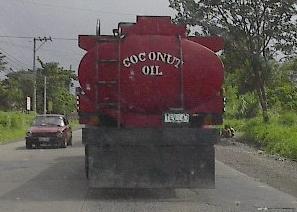
A typical site
on the road in the Philippines: a truck carrying refined coconut
oil.
Refined
Coconut Oil
Most commercial grade coconut oils
are made from copra. Copra is basically the dried kernel (meat)
of the coconut. It can be made by: smoke drying, sun drying,
or kiln drying , or derivatives or a combination of these
three. If standard copra is used as a starting material, the
unrefined coconut oil extracted from copra is not suitable
for consumption and must be purified, that is refined. This
is because the way most copra is dried is not sanitary. The
standard end product made from copra is RBD coconut oil. RBD
stands for refined, bleached, and deodorized. High heat is
used to deodorize the oil, and the oil is typically filtered
through (bleaching) clays to remove impurities. Sodium
hydroxide is generally used to remove free fatty acids and
prolong shelf life. This is the most common way to
mass-produce coconut oil. The older way of producing refined
coconut oil was through physical/mechanical refining. More modern methods also use
chemical solvents to extract all the oil from the copra for
higher yields.
RBD oil is also sometimes hydrogenated or
partially hydrogenated. This happens mostly in tropical climates,
since the natural melting point of coconut oil is about 76
degrees F, and already naturally a solid in most colder climates.
Since coconut oil is mostly saturated, there is little unsaturated
oil left to hydrogenate. Hydrogenated oils contain trans fatty
acids.
Virgin Coconut Oil
There is no industry standard definition
for "Virgin Coconut Oil" as there is in the olive oil
industry for "Virgin" and "Extra Virgin" olive oil. Today,
there are many coconut oils on the market that are labeled
as "Virgin Coconut Oil." We were the first ones to publish
standards for the use of "Virgin Coconut Oil" in terms of
edible oils, and here is what we published over eight
years ago:
Virgin Coconut Oil can only be achieved
by using fresh coconut meat or what is called non-copra. Chemicals
and high heating are not used in further refining, since the
natural, pure coconut oil is very stable with a shelf life
of several years. There are currently two main processes of
manufacturing Virgin Coconut Oil:
1. Quick drying of fresh coconut meat which
is then used to press out the oil. Using this method, minimal
heat is used to quick dry the coconut meat, and the oil is
then pressed out via mechanical means.
2. Wet-milling. With this method the oil
is extracted from fresh coconut meat without drying first.
"Coconut milk" is expressed first by pressing. The
oil is then further separated from the water. Methods which
can be used to separate the oil from the water include boiling,
fermentation, refrigeration, enzymes and mechanical centrifuge.
The method we use at Mt. Banahaw Health Products
Corp. in the Philippines is fermentation. The coconut milk
expressed from the freshly harvested coconuts is fermented
for 24-36 hours. During this time, the water separates from
the oil. The oil is then slightly heated for a short time
to remove moisture, and filtered. The result is a clear coconut
oil that retains the distinct scent and taste of coconuts.
This is a traditional method of coconut oil extraction that
has been used in the Philippines for hundreds of years. Laboratory
tests show that this is a very high quality coconut oil, with
the lauric acid content being 50 to 55%. This oil is not mass
produced, but made by hand just as it has been done for hundreds
of years. Since we live in the community where the coconuts
grow, we personally guarantee that the best organic coconuts
available are used in producing this Virgin Coconut Oil, and
that no chemicals whatsoever are used in the growing or processing
of the coconuts. Our coconuts are also certified organic according
to strict USDA standards. In addition, all of our coconuts
are hand-picked within 24 hours of harvest. Only those nuts
that produce the highest quality coconut oil are chosen, while
the rest of the crop is sold to copra dealers. Almost all
other virgin coconut oils on the market are mass-produced.
Our organic Virgin Coconut Oil is marketed in the US
exclusively under the brand name "Tropical Traditions."

Delivering Virgin
Coconut Oil to the Mt. Banahaw warehouse in 5-gallon pails.
Many of our producers live in rural areas in coconut-producing
communities where no roads exist, and draft animals like the
water buffalo are used.

Bringing in young
coconuts from the farm and loaded onto a jeepney to be transported
to the market.
One of the main differences between Virgin
Coconut oil and refined coconut oils is the scent and taste.
All Virgin Coconut Oils retain the fresh scent and taste of
coconuts, whereas the copra-based refined coconut oils have
a bland taste due to the refining process. Some grades of
refined copra-based oils are also now sold that have a coconut
flavor, but are usually bitter and have a burnt taste to it.
They are a form of "crude coconut oil" that has
not undergone all of the deodorizing process, and they have
a shorter shelf-life.
A recent study done in India comparing refined coconut oil
(CO) with Virgin Coconut Oil (VCO) found that VCO obtained by
wet process has a beneficial effect in lowering lipid
components compared to CO. It reduced total cholesterol,
triglycerides, phospholipids, LDL, and VLDL cholesterol levels
and increased HDL cholesterol in serum and tissues. The
results demonstrated the potential beneficiary effect of
virgin coconut oil in lowering lipid levels in serum and
tissues and LDL oxidation by physiological oxidants. This
property of VCO may be attributed to the biologically active
polyphenol components present in the oil.
What is "Extra
Virgin Coconut Oil?"
Some retailers and manufacturers of Virgin
Coconut Oils, referring to one of the processes mentioned
above, call their coconut oil "Extra Virgin Coconut Oil."
But there are no other processes used to make coconut oil
other than the ones mentioned above, so this classification
is simply arbitrary. There is no official classification or
difference between "virgin" and "extra virgin"
as there is in the olive oil industry, since the two oils
are completely different in fatty acid composition, harvesting
procedures, and terminology.
Coconut Oil: The Healthy Oil
Numerous studies now show that the high lauric
acid content of coconut oil is very beneficial in attacking
viruses, bacteria, and other pathogens, and that it builds
the body's immune system just as human mother's milk does,
which also contains lauric acid. Promising studies have been
done on patients suffering from immune deficiency diseases,
such as AIDS. See
the research. With polyunsaturated seed oils now
largely replacing coconut oil in the American diet, there
is a huge deficiency of lauric acid in the American diet that
was present prior to World War II. The need for quality coconut
oil is greater than ever!
Was
this article helpful to you? Share it with others:

|